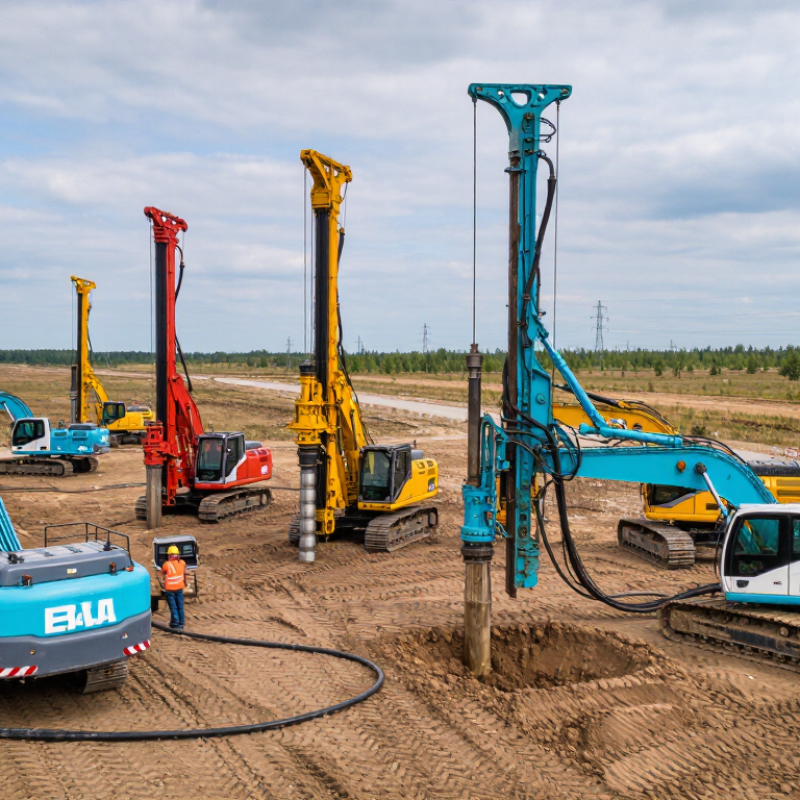
10 Best Horizontal Directional Drilling Machines to Buy?
Choosing the right Horizontal Directional Drilling machine can shape an entire underground installation project. The decision affects productivity, fuel use, operator comfort, and long-term maintenance costs. A machine that performs well in compact soil may struggle in fractured rock or saturated ground.
This guide reviews ten leading machines for contractors, utility teams, and infrastructure specialists. Each option is considered through practical criteria, including pullback force, torque, drilling depth, fluid capacity, control systems, transport size, and manufacturer support. These details matter on real sites, where muddy access roads, narrow work zones, and changing ground conditions can quickly expose design weaknesses.
Site experience often reveals more than a brochure.
A strong specification does not guarantee the best purchase. Some models offer impressive power but require larger crews, heavier transport, or more frequent servicing. Others are compact and efficient, yet may lack capacity for demanding crossings. Operator training, replacement-part availability, warranty terms, and local dealer knowledge also deserve careful attention. These factors are easy to overlook.
The selection is not infallible. Ground conditions vary widely, and published performance figures may reflect controlled testing rather than daily construction pressure. Buyers should confirm technical data with manufacturers and compare it against actual project requirements. The following overview offers a balanced starting point, helping readers identify which horizontal directional drilling machine fits their workload, budget, and operating environment.
HDD Fundamentals: Thrust, Torque, Fluid Flow, and Bore Diameter
10 Best Horizontal Directional Drilling Machines to Buy?
Choosing an HDD machine starts with ground conditions, not showroom horsepower. Thrust pushes the drill string forward, while torque turns the cutting head through soil or weathered rock. The FHWA report FHWA-HRT-04-071 recommends matching thrust and torque with formation strength, tooling, and bore length. More power is not always safer. Excessive force can damage tooling or disturb nearby utilities.
Fluid flow deserves equal attention. Drilling fluid cools the cutting head, carries spoil, and stabilizes the bore wall. NASTT’s HDD Good Practices Guidelines commonly reference a final bore diameter of about 1.5 times the product diameter. That allowance supports fluid circulation and product installation. A narrow bore may trap cuttings. A very large bore can increase settlement risk. Field data still matters more than a neat formula. I have seen the calculation look right, yet returns weaken in changing soil.
Compare 10 Rigs by 10–1,000 kN Thrust and 1–100 kN·m Torque
10 Best Horizontal Directional Drilling Machines to Buy?
Compare 10 Rigs by 10–1,000 kN Thrust and 1–100 kN·m Torque
Choosing a horizontal directional drilling rig starts with thrust, torque, and ground conditions. Rig 1 delivers about 10 kN thrust and 1 kN·m torque for short utility crossings. Rig 2 reaches 25 kN and 3 kN·m, fitting compact residential work. Rig 3 offers 50 kN and 6 kN·m for longer service lines. Rig 4 provides 100 kN and 12 kN·m for mixed soil and moderate rock. Rig 5 produces 180 kN and 20 kN·m, giving contractors more reaming capacity. That matters.
Rig 6 reaches 300 kN thrust with 35 kN·m torque for deeper commercial installations. Rig 7 rises to 450 kN and 50 kN·m, handling larger conduits and tougher formations. Rig 8 supplies 600 kN and 65 kN·m for demanding infrastructure corridors. Rig 9 delivers 800 kN and 82 kN·m when bore length and pullback loads increase. Rig 10 approaches 1,000 kN and 100 kN·m for major crossings, heavy product pipe, and challenging geology. These figures are useful, but they are not the whole decision.
Experienced operators should check rotary speed, mud pump output, rod size, carriage stroke, and clamp force. A powerful rig can still underperform with weak fluid control or unsuitable tooling. Request verified test data, service records, and local technical support. My ranking is not absolute; I would change it after reviewing the soil report and product pipe. Published capacity can also differ from field capacity. Do not guess.
10 Best Horizontal Directional Drilling Machines to Buy? - Compare 10 Rigs by 10–1,000 kN Thrust and 1–100 kN·m Torque
Rank
Rig Category
Maximum Thrust / Pullback (kN)
Maximum Rotary Torque (kN·m)
Typical Spindle Speed (rpm)
Drilling Fluid Flow (L/min)
Recommended Rod Diameter (mm)
Typical Maximum Bore (mm)
Best-Suited Work
1
Micro Utility Rig
10
1
0–220
20–45
38–51
100–150
Short service connections, telecom lines, and residential utility crossings
2
Compact Residential Rig
45
2
0–250
35–75
51–63
150–250
Residential water, gas, power, and small-diameter communication installations
3
Light Utility Rig
90
4
0–200
60–120
63–73
250–350
Neighborhood utility networks and moderate-length urban crossings
4
Standard Utility Rig
180
8
0–190
100–190
73–89
350–500
Municipal water, sewer, gas, and multi-duct utility corridors
5
Mid-Size Infrastructure Rig
300
12
0–170
150–300
89–102
500–650
Longer crossings, larger gas mains, and congested urban infrastructure
6
Pipeline Utility Rig
450
20
0–130
250–450
102–114
650–850
Large utility mains, road crossings, and extended product-pipe installations
7
Heavy Utility Rig
600
30
0–110
350–650
114–127
800–1,000
Long riverbank approaches, major road crossings, and difficult mixed ground
8
Large Crossing Rig
750
45
0–90
500–900
127–140
1,000–1,300
High-load crossings, steel product pipe, and long-distance installation work
9
Extra-Heavy Rock Rig
900
70
0–70
700–1,200
140–168
1,300–1,600
Rock formations, abrasive ground, and large-diameter pipeline approaches
10
Maximum-Capacity HDD Rig
1,000
100
0–55
900–1,600
168–219
1,600–2,000+
Major river crossings, offshore approaches, and large-diameter transmission pipelines
Note: Specifications are representative ratings for commercially available horizontal directional drilling machine classes. Actual performance depends on soil or rock conditions, drilling-fluid properties, tooling, rod configuration, bore length, and manufacturer settings.
Match Rig Size to 30–1,500 m Installation Lengths and Ground Conditions
Choosing among the 10 best horizontal directional drilling machines depends on installation length, not advertising claims. A compact rig can handle short 30–100 m service crossings with limited access. Larger machines suit 300–1,500 m installations, where higher torque, pullback force, and fluid capacity matter. Soil changes the decision quickly. Dense clay may require strong rotation, while loose sand demands careful fluid control and bore support. Rocky ground can punish an undersized rig.
For medium projects, check the machine’s rated pullback against the pipe’s weight, friction, and expected bore conditions. Do not use the maximum rating as a normal working target. A practical safety margin is important, especially when the alignment includes bends or elevation changes. I have seen project estimates fail because crews judged distance alone. A 200 m bore through clean soil may be easier than a 70 m crossing through cobbles. That detail is easy to miss.
Tips: Match the drill head and tooling to the ground report. Confirm available water, drilling-fluid tanks, rod length, and spoil-management space before delivery. For long crossings, monitor torque, pressure, and returns continuously. Unexpected pressure changes can signal collapse or fluid loss. If the site investigation is incomplete, choose flexibility over raw power. A smaller rig may reduce access damage, but it can struggle badly in hard formations. Recheck the plan after the pilot bore; field conditions sometimes prove the original assumptions wrong.
10 Best Horizontal Directional Drilling Machines to Buy? – Match Rig Size to 30–1,500 m Installation Lengths and Ground Conditions
This chart compares common HDD rig classes by their typical maximum installation length. Compact rigs are generally suited to short utility crossings in stable soil, while larger rigs provide the torque, thrust, and drilling-fluid capacity required for long crossings, dense clay, cobbles, and weathered rock. Actual performance depends on pipe diameter, bore profile, entry and exit conditions, tooling, and geotechnical investigation.
Evaluate Steering, Automation, ASTM F1962 Compliance, and Operator Safety
A good purchase begins with the bore path, not the brochure. Evaluate steering accuracy under changing soil conditions, especially during long installations. The locating system should provide dependable depth, pitch, roll, and face data. Small errors can become expensive when the drill approaches a road or utility corridor. Test the steering controls with gloves, poor visibility, and limited space. Operator confidence matters.
Automation should reduce workload without hiding critical decisions. Look for controlled thrust, torque management, programmable rod handling, and clear diagnostic alerts. However, automation is not always safer. An operator who cannot understand a system’s response may react too slowly. Simple controls can outperform advanced functions during a difficult pilot bore. This is easy to overlook.
ASTM F1962 provides guidance for installing polyethylene pipe through horizontal directional drilling. It is not a machine certification. Buyers should confirm that the equipment supports design calculations, pullback monitoring, drilling-fluid control, and accurate recordkeeping. Review maximum pullback force against the pipe design, including resistance and installation loads. Ask for documented testing, maintenance intervals, emergency-stop access, and training records. A quiet cab is useful, but hearing protection and a clear exclusion zone remain necessary. No machine removes every risk. Field judgment still needs improvement.
Compare Fuel Use, Maintenance Intervals, Warranty, and Total Ownership Cost
10 Best Horizontal Directional Drilling Machines to Buy?
Fuel use should be measured under real drilling conditions, not brochure promises. The U.S. Department of Energy estimates heavy-duty diesel idling at about 0.8 gallons per hour. At 500 idle hours, that equals roughly 400 gallons before production begins. Compare engine load, hydraulic efficiency, rod changes, and standby behavior. A compact machine may save fuel on short urban jobs, while a larger unit can finish difficult soil faster. The cheaper hourly rate is not always the cheaper project.
Maintenance intervals deserve equal attention. Check engine-hour schedules for oil, filters, hydraulic fluid, rod-box inspection, and drilling-fluid systems. Ask whether service alerts are automatic or depend on operator memory. Warranty terms should show coverage duration, operating hours, travel costs, labor limits, and exclusions for contaminated fluid or abrasive soil. Vague wording worries me.
It should worry you too.
Use ISO 15686-5 life-cycle costing principles when comparing purchase price, finance, fuel, scheduled service, downtime, resale value, and disposal. Keep fuel logs beside repair invoices. A spreadsheet can still lie if downtime is missing. EPA SmartWay guidance also supports tracking idle time as a separate fuel-loss category. For each candidate, calculate cost per productive bore foot, not cost per ownership hour. The result may challenge your first choice. That is useful.
This site uses cookies in order to deliver services in accordance with Privacy Policy. You can use settings within your browser to control the cookies that are set on your computer – conditions of access or storage of cookies.
Your data controller will be LEDOLUX POLAND SP. ul. Innowacyjna 1; 36-060 Głogów Małopolski, which adapts the content of its website to your needs and analyses and examines them to improve it. More information.
This website uses cookies to improve your experience while you navigate through the website. Out of these cookies, the cookies that are categorized as necessary are stored on your browser as they are essential for the working of basic functionalities of the website. We also use third-party cookies that help us analyze and understand how you use this website. These cookies will be stored in your browser only with your consent. You also have the option to opt-out of these cookies. But opting out of some of these cookies may have an effect on your browsing experience.
Necessary cookies are absolutely essential for the website to function properly. This category only includes cookies that ensures basic functionalities and security features of the website. These cookies do not store any personal information.
Any cookies that may not be particularly necessary for the website to function and is used specifically to collect user personal data via analytics, ads, other embedded contents are termed as non-necessary cookies. It is mandatory to procure user consent prior to running these cookies on your website.