

Choosing the right Forklift Actuator in 2026 requires more than comparing prices or advertised lifting force. A warehouse technician sees the real test: smooth mast movement, stable load positioning, and reliable operation during a cold morning shift. The actuator influences safety, energy use, noise, and maintenance time. Small errors become expensive quickly.
Industry data supports this practical concern. The World Industrial Truck Statistics (WITS) reports continued global demand for industrial trucks, increasing pressure on fleets to improve uptime and operator safety. The MHI 2024 Industry Report also identifies labor shortages and technology investment as major material-handling priorities. These trends make actuator selection a maintenance decision, not merely a purchasing decision. Yet market forecasts often group forklifts with wider industrial equipment. Their figures may not describe actuator performance directly. That limitation deserves attention.
This guide examines load capacity, stroke length, duty cycle, response speed, mounting geometry, environmental protection, and control compatibility. It also considers ISO 3691-1 safety expectations and OSHA powered industrial truck training requirements where applicable. A suitable actuator should match the forklift’s actual working pattern, including repeated pallet stacking, uneven floors, dust, and temperature changes. Laboratory specifications are useful. Field evidence matters more.
No checklist is perfect. A low-cost actuator may perform well in light service but fail under continuous cycles. A premium model may be unnecessary for occasional warehouse use. Reviewing service records, failure symptoms, supplier testing, and warranty terms can reveal the better choice. The following sections provide a structured method for making that decision with clearer evidence and fewer assumptions.
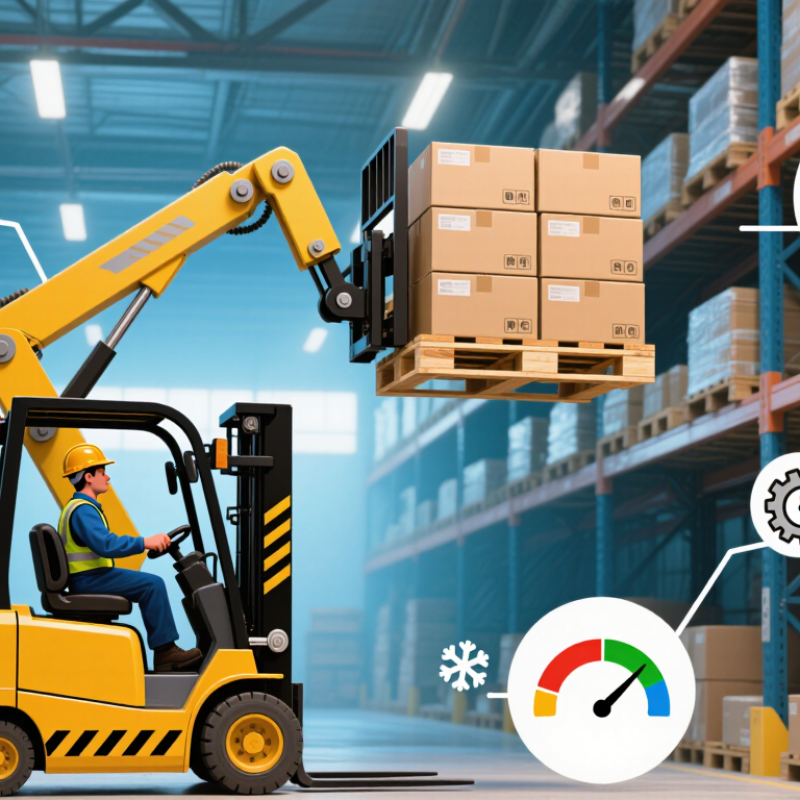
A forklift actuator converts control input into movement. It may raise the mast, tilt the carriage, steer the wheels, or position an attachment. In a busy warehouse, that movement appears simple. It is not. A hydraulic actuator must handle pressure, shock loads, heat, and repeated cycling. An electric actuator also needs accurate feedback and protected wiring. A small delay can leave a pallet leaning several centimeters.
The safety value is measurable. OSHA estimates that forklifts cause about 85 fatal injuries and 34,900 serious injuries each year in the United States. These figures show why actuator selection is not only a performance decision. It affects load stability, stopping behavior, and operator control. ISO 3691-1 also emphasizes safe design and operating conditions for industrial trucks. Choose the actuator by rated load, stroke, speed, duty cycle, temperature, and contamination exposure. Do not trust maximum force alone. A neat specification sheet can still mislead.
Tips: Check the heaviest real load, not the average pallet. Measure peak pressure during lifting and tilting. Confirm emergency-lowering behavior. For electric systems, inspect feedback accuracy, connector sealing, and cable bend radius. Request cycle-test results from the supplier. Field trials matter. They may reveal vibration, noise, or heat that laboratory numbers hide. Recheck the choice after six months; usage often changes faster than expected.
How to Choose a Forklift Actuator in 2026?
Selecting an actuator starts with the forklift function, not the actuator catalog. A linear electric actuator suits fork positioning and side-shift tasks. It offers controlled movement, clean operation, and simple feedback integration. Hydraulic cylinders remain practical for mast tilt and high-force lifting attachments. Rotary actuators fit rotating clamps or specialized positioning tools. Match stroke, force, speed, and duty cycle to the real workload. A cold warehouse, uneven floor, or frequent reversing can change the answer. OSHA estimates that forklift incidents cause about 85 fatalities and 34,900 serious injuries annually in the United States. The OSHA Powered Industrial Trucks eTool therefore supports careful stability and control assessments.
For mast tilt, calculate force at the cylinder connection, not only rated load capacity. Load center distance matters. For side-shift, prioritize smooth low-speed control and backlash resistance. For clamps, check holding force during pressure loss. ISO 3691-1:2023 emphasizes stability, control, and operator protection for industrial trucks. These requirements make position feedback and mechanical stops more than optional upgrades. I have seen designs fail because engineers selected peak force alone. The actuator survived, but the mounting bracket did not. That mistake deserves more attention.
Tips: Record ten operating cycles before specifying the actuator. Measure actual stroke, cycle time, temperature, and peak load. Add a safety margin, but avoid oversized units that waste energy. Verify ingress protection, emergency behavior, and service access. A neat spreadsheet is not enough. Test the complete linkage under realistic loads.
How to Choose a Forklift Actuator in 2026?
Which Load, Speed, and Stroke Specifications to Check
Selecting a forklift actuator starts with the real load, not the catalog rating. Measure the attachment, carriage, and lifted materials together. Include offset weight from clamps or forks. I have seen small offsets create surprisingly high actuator forces. Static calculations are not enough. Add acceleration, braking, uneven floors, and repeated impacts. A practical safety margin helps, but excessive margin can increase size, cost, and energy use.
Load comes first. Check both pushing and pulling capacity. Confirm whether the rating applies continuously or only for short cycles. Then match the required speed to the work process. A slow actuator may delay pallet handling, while excessive speed can reduce control. Record the travel time during normal shifts. Do not rely on a single test. Real work is less tidy.
Stroke must cover the full mechanical movement without bottoming out. Measure the retracted and extended positions on the actual forklift. Leave clearance for mounting brackets, guards, and cable movement. Check the duty cycle, temperature, dust, moisture, and vibration. These details often determine service life. My first estimate was too optimistic because I ignored side loading. The revised design used proper guidance and a shorter unsupported span. Also verify emergency stopping behavior, manual release needs, and mounting alignment before installation.
How to Choose a Forklift Actuator in 2026?
An actuator must match real lifting loads, not catalogue ratings alone. Measure payload, attachment weight, travel speed, and duty cycle. Include starting torque and repeated peak current. A linear electric actuator may suit precise, clean movement. Hydraulic systems can deliver high force, but leakage risks increase maintenance demands. OSHA reports about 85 fatal forklift accidents and 34,900 serious injuries annually in the United States. Control reliability is therefore a safety requirement, not a convenience.
Evaluate feedback before selecting the control architecture. Position sensors, limit switches, current monitoring, and fault feedback can prevent overtravel. The controller should communicate clearly with the vehicle’s safety system. Check response time under low battery voltage. A stable bench test can hide problems during cold starts. It happens more often than expected. ISO 3691-1 emphasizes functional safety for industrial trucks, while IEC 60529 defines protection ratings against dust and water. These standards guide testing, but they do not replace application-specific validation.
Environmental conditions often decide actuator life. Review temperature range, vibration, washdown pressure, corrosion, and airborne dust. A high ingress-protection rating is useful, but cable glands and connectors still need attention. The U.S. Department of Energy’s Industrial Decarbonization Roadmap identifies industry as responsible for roughly 30% of national energy use. Efficient actuator sizing can reduce wasted battery energy and heat. However, efficiency figures may ignore standby consumption and control losses. Specify measured performance across the full operating cycle, including winter starts and heavily loaded turns.
The chart presents representative engineering targets for common forklift applications. Heavy-duty forklifts generally require higher actuator force and electrical input, while warehouse trucks prioritize compact design, lower power consumption, and dependable response. Response time is shown in milliseconds, so lower values indicate faster control.
Environmental selection should also consider dust, water exposure, vibration, temperature, and wash-down conditions. IP54 is commonly suitable for protected indoor use, while IP65 or higher is preferred for exposed outdoor or wash-down environments. Final values must be verified against the truck duty cycle, load geometry, battery voltage, and applicable safety requirements.
How to Choose a Forklift Actuator in 2026?
Choosing a forklift actuator requires more than checking lifting force. Safety, maintenance, and total operating cost should be compared together. Start with the actuator’s rated load, stroke length, duty cycle, and operating temperature. A unit that works well in a clean warehouse may struggle near dust, moisture, or cold loading bays. Check overload protection, position feedback, emergency stopping behavior, and mechanical holding performance. Ask for test records, installation guidance, and traceable technical documentation. These details show whether the supplier understands real warehouse risks, not only catalog figures.
Maintenance often decides the real price. Inspect sealing quality, connector protection, lubrication needs, and access to replaceable parts. A simple inspection can prevent a long vehicle shutdown. Record service intervals and labor minutes for each actuator. Then estimate energy use, replacement parts, downtime, training, and disposal costs over its expected life. Do not trust the lowest purchase price. It may hide difficult access or frequent calibration. I have seen maintenance estimates look precise while ignoring one awkward mounting bolt. That small omission can change the calculation.
Tips: Compare actuators on the same duty cycle. Request a sample maintenance checklist. Test stopping accuracy with a loaded fork, not an empty one. Keep a spare only when downtime costs justify it. Recheck assumptions after three months of operation. Some early estimates will be wrong. That is useful data.
| Actuator Type | Typical Forklift Function | Typical Operating Force / Pressure | Safety Characteristics | Maintenance Profile | Typical Service Life | Energy Efficiency | Estimated 5-Year Operating Cost | Best-Fit Application |
|---|---|---|---|---|---|---|---|---|
| Electromechanical Linear Actuator | Attachment positioning, fork adjustment, side-shift assistance, and auxiliary mast functions | Approximately 2–15 kN; commonly supplied at 12, 24, or 48 V DC | Can provide controlled speed, position feedback, overload protection, and fail-safe braking. A mechanical lock or holding brake is recommended for load-holding applications. | Low routine maintenance. Inspect mounting points, wiring, seals, brake function, and backlash every 500–1,000 operating hours. | Typically 8,000–15,000 operating hours, depending on load cycles, duty cycle, and environmental exposure | High for intermittent motion; energy is consumed mainly during movement and holding efficiency depends on the brake and screw design | USD 1,200–3,000 per unit, including typical service parts and planned inspections | Electric forklifts, clean warehouses, automated equipment, and applications requiring accurate positioning |
| Hydraulic Cylinder | Mast lift, tilt, reach, fork positioning, and high-force attachment movement | Approximately 70–210 bar system pressure; force depends on bore diameter and pressure | High force density and good load control when equipped with load-holding valves, hose-burst protection, and correctly sized relief valves. Hydraulic leaks can create slip and environmental hazards. | Inspect hoses, fittings, rod seals, fluid level, contamination, and drift. Hydraulic oil and filters normally require scheduled service according to the truck manufacturer’s duty cycle. | Typically 10,000–20,000 operating hours when contamination is controlled and seals are correctly maintained | Moderate; losses occur through pump efficiency, throttling, heat generation, and pressure relief | USD 1,800–4,500 per unit, including hydraulic fluid, filters, seals, hose replacement, and planned repairs | Heavy-duty lifting, rough operating environments, high-force attachments, and conventional industrial forklifts |
| Pneumatic Cylinder | Light-duty clamps, gates, stops, positioning devices, and auxiliary attachment functions | Approximately 4–8 bar air pressure; force is generally lower than hydraulic systems | Fast response and simple construction. Safe design requires pressure regulation, exhaust control, guarding against pinch points, and a method to prevent unintended movement after air loss. | Inspect air lines, fittings, rod seals, moisture separators, and lubrication requirements. Compressed-air leaks should be repaired promptly. | Typically 5,000–12,000 operating hours, heavily influenced by air quality, side loading, and cycle frequency | Low to moderate at system level because compressed-air generation and leakage can consume substantial energy | USD 1,500–4,000 per unit, including compressed-air losses, seals, fittings, and scheduled service | Clean, light-duty environments where rapid cycling is more important than maximum force or energy efficiency |
| Electro-Hydraulic Actuator | High-force lifting or attachment control on electric forklifts and hybrid material-handling equipment | Approximately 70–210 bar hydraulic pressure with an electrically driven pump | Combines hydraulic force with electronic control. Recommended features include pressure relief, load-holding valves, position sensing, emergency stop integration, and diagnostic monitoring. | Requires both electrical inspection and hydraulic service. Monitor battery current, pump noise, fluid temperature, filters, hoses, seals, and control software faults. | Typically 8,000–18,000 operating hours, depending on thermal management and duty cycle | Moderate to high; usually more efficient than engine-driven hydraulics during intermittent operation, but standby losses still depend on pump control | USD 2,500–6,000 per unit, including hydraulic service, electrical diagnostics, filters, seals, and control components | Electric forklifts requiring hydraulic-level force with reduced engine emissions and electronically managed operation |
| Servo Electric Actuator | Automated fork positioning, synchronized attachment movement, precision side-shift, and robotic forklift functions | Approximately 1–20 kN; force and speed depend on motor, gearbox, screw, and control system selection | Excellent repeatability and controllability. Use redundant position monitoring, torque limits, emergency stopping, and a mechanical holding method where a suspended load could create a hazard. | Low mechanical maintenance but requires inspection of couplings, gearboxes, screw lubrication, cables, encoders, and software alarms. | Typically 10,000–20,000 operating hours in controlled environments | High during motion and automation cycles; regenerative braking may reduce net energy use when supported by the drive system | USD 2,500–7,000 per unit, including calibration, encoder replacement, lubrication, and control-system diagnostics | Automated warehouses, high-cycle operations, precision handling, and systems with digital fleet monitoring |
TERMS OF USE - LEDOLUX
This site uses cookies in order to deliver services in accordance with Privacy Policy. You can use settings within your browser to control the cookies that are set on your computer – conditions of access or storage of cookies.
Your data controller will be LEDOLUX POLAND SP. ul. Innowacyjna 1; 36-060 Głogów Małopolski, which adapts the content of its website to your needs and analyses and examines them to improve it. More information.