Top Tips for Choosing the Right Infrared Bandpass Filter?
Choosing the right Infrared Bandpass Filter can be a daunting task for developers and engineers. According to the market report published by Research and Markets, the global infrared filter market is expected to reach $1.3 billion by 2026. This growth is fueled by rising applications in various sectors, such as telecommunications and medical diagnostics.
Expert Dr. Helen Matthews, a leading figure in optical technology, notes, "Selecting an appropriate infrared bandpass filter is crucial for optimal system performance." Her insights emphasize the importance of understanding specific needs before making a decision. With various options available, it’s essential to consider factors such as wavelength range and transmission efficiency.
Before diving into the selection process, developers must reflect on their application requirements. Not every filter suits every scenario. Functionality, durability, and budget constraints must all be balanced. The path to finding the right infrared bandpass filter entails careful consideration and thorough research, ultimately leading to informed decisions that enhance project outcomes.
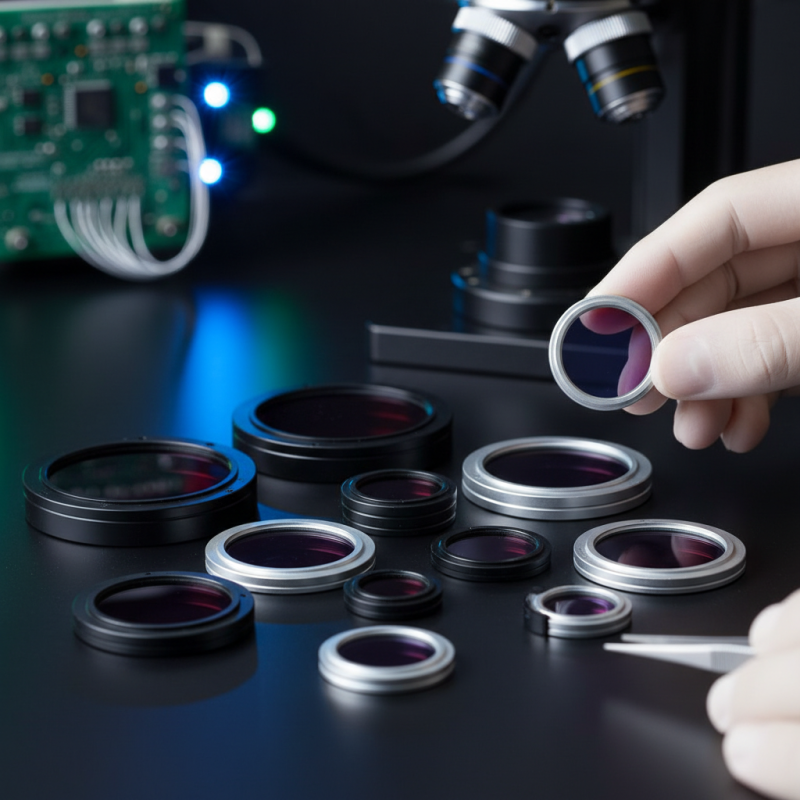
Understanding the Basics of Infrared Bandpass Filters
Infrared bandpass filters play a crucial role in many optical systems. These filters allow specific wavelengths of infrared light to pass through while blocking others. Understanding their function involves delving into their composition and characteristics.
When selecting an infrared bandpass filter, consider its specifications. The center wavelength is vital. It determines which frequencies will be transmitted. The bandwidth is also essential. A narrow bandwidth offers precise filtering, while a wider band can capture more data.
Another factor to assess is the filter’s transmission efficiency. This describes how much light can pass through versus how much is blocked. Look for filters that balance high transmission with the right wavelength range. It’s essential to test filters under real conditions. Reflecting on the performance is critical. Different applications may require adjustments. Overall, choosing the right filter involves a mix of technical knowledge and practical evaluation.
Key Factors to Consider When Selecting Infrared Filters
Selecting the right infrared bandpass filter requires careful consideration of several key factors. Understanding the wavelength range is crucial. Infrared filters may vary widely in their spectral transmission. Knowing the specific wavelengths relevant to your application will ensure better performance. For example, some filters target shortwave infrared (SWIR), while others focus on mid-wave infrared (MWIR). Identifying this range can simplify your decision.
Another important aspect is the filter material. Commonly used materials include glass, crystals, and polymers. Each has unique properties that influence performance. For instance, glass is typically durable, while certain crystals offer superior transmission in specific wavelengths. Also, consider the filter's optical density. A higher optical density can block unwanted light better but may also reduce the overall intensity of the desired signal.
Be aware of your system’s requirements. The filter must fit well within the optical setup. In some instances, even minor misalignments can compromise the performance. It’s also wise to assess the environmental conditions where the filter will operate. High temperatures or humidity can affect performance and lifespan. Reflect on your analysis process; not all factors may align perfectly with initial expectations, but thorough research can lead to better outcomes.
Types of Infrared Bandpass Filters and Their Applications
When selecting infrared bandpass filters, understanding their types is crucial. There are several primary categories. Narrowband filters are designed for specific wavelengths. They offer high precision, often used in spectroscopy and infrared imaging. Their pinpoint accuracy helps in obtaining clear data. However, they can be costly, and slightly misaligning them can impact results.
Broadband filters cover wider infrared ranges. They are versatile and can be valuable in different applications, such as environmental monitoring. Yet, they may not provide the same level of detail as narrowband filters. Depending on the application, it’s essential to choose wisely. Bandpass filters can be high-end optical components but require careful handling. Misuse or improper installation may result in subpar performance. It's a delicate balance between performance and budget.
Top Tips for Choosing the Right Infrared Bandpass Filter
| Filter Type | Wavelength Range (μm) | Transmission (% @ Center) | Application |
| Near-Infrared Filter | 0.70 - 1.10 | 85% | Spectroscopy, Remote Sensing |
| Mid-Infrared Filter | 3.00 - 5.00 | 90% | Thermal Imaging, Environmental Monitoring |
| Far-Infrared Filter | 8.00 - 14.00 | 75% | Medical Imaging, Industrial Applications |
Evaluating Filter Performance Metrics for Your Needs
When selecting an infrared bandpass filter, it's crucial to evaluate performance metrics that align with your specific application. Understanding how different filters perform can help narrow down choices based on parameters like transmission range and wavelength precision. Filters can vary significantly in these metrics, impacting their effectiveness in your project.
One of the key tips is to assess the filter's transmission curve. Look for filters that deliver high transmittance within your desired wavelength range. A flat and wide transmission peak indicates better performance for most applications. Additionally, consider the filter’s blocking range to ensure it effectively minimizes unwanted wavelengths. This can be especially important in sensitive imaging systems where clarity is paramount.
Another essential point is to analyze the filter’s temperature stability. Fluctuations can lead to performance degradation. Check the specifications for temperature coefficients. Filters that can maintain consistent performance across a range of temperatures are more reliable for long-term use. Don't overlook how the filter interacts with surrounding materials. Sometimes, reflections can create unexpected issues if not carefully managed.
Maintenance Tips for Prolonging the Life of Infrared Filters
Maintaining infrared filters is essential for ensuring optimal performance and longevity. Infrared filters are sensitive components, easily affected by environmental factors. Data suggests that improper storage can significantly reduce a filter's lifespan. For instance, filters stored in areas with high humidity may develop moisture-related damage. Keeping filters in a dry and controlled environment is crucial.
Regular cleaning of infrared filters is also a key maintenance practice. Dust and contaminants can affect performance. Use a soft, lint-free cloth for gentle cleaning. Avoid harsh chemicals and abrasive materials. Hand oils can create smudges. Frequent checks can prevent these issues from becoming serious problems.
Another consideration is ensuring that filters are properly mounted. Misalignment can lead to distortion. It's vital to follow precise mounting guidelines during installation. Addressing these details helps maintain the integrity of the filter. Over time, neglecting such elements may cause irreversible damage. Being proactive can save both time and costs in the long run.
Top Tips for Choosing the Right Infrared Bandpass Filter
This chart illustrates key factors to consider when choosing an infrared bandpass filter. The data highlights characteristics such as transmission efficiency, durability, cost, temperature range, and size, which are essential for optimal performance and longevity of infrared filters.