

What Are the Top Types of Tea Sorting Machines in 2026?
Tea processing is entering a more demanding phase in 2026. Global tea production has remained above six million tonnes annually, according to recent FAO Intergovernmental Group on Tea data. The International Tea Committee’s 2024 statistics also show strong production from China, India, Kenya, and Sri Lanka. Larger volumes create tighter quality expectations. Manual inspection alone cannot consistently detect pale stems, mould-damaged leaves, stones, or uneven grades at high conveyor speeds.
This is where a Tea Sorting Machine becomes important. Modern factories are moving beyond basic visual separation. Color sorting machines use RGB cameras to identify shade differences. Near-infrared systems examine moisture and material composition. AI vision sorters learn from images of broken leaves, foreign particles, and unwanted stalks. Hyperspectral equipment provides deeper spectral information, although its cost and maintenance requirements remain significant. Optical sorting market analyses from Grand View Research and Mordor Intelligence indicate continued investment in automated inspection and sensor-based food processing. Their market boundaries differ, so their forecasts should not be treated as identical evidence.
Real factory performance depends on more than camera resolution. Operators must control leaf thickness, belt vibration, lighting, dust, and calibration. A sorting line may appear accurate during a clean trial, yet lose efficiency when wet leaves enter the hopper. That detail matters. The best machine is not always the most advanced model. It should match tea variety, factory capacity, defect profile, and acceptable product loss. This guide examines the top Tea Sorting Machine types expected in 2026, while questioning exaggerated accuracy claims and highlighting practical selection criteria. No machine is perfect. Careful testing still decides the result.
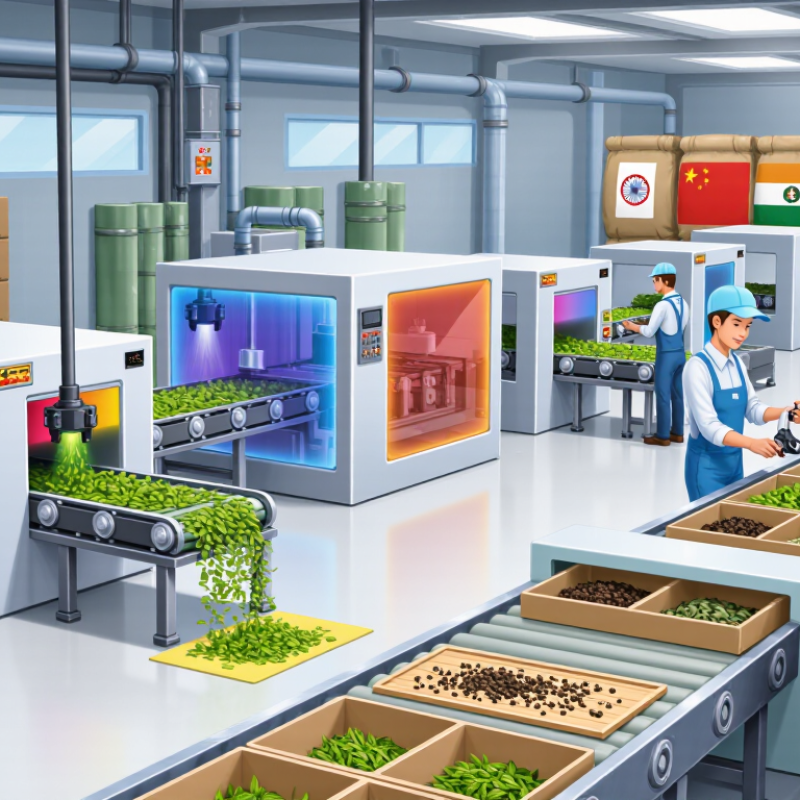
Color Sorters: RGB/NIR Channels, Ejection Speed, and Accuracy Metrics
What Are the Top Types of Tea Sorting Machines in 2026?
Color sorters remain important for removing uneven leaves, stems, dust, and foreign-colored particles from processed tea. RGB channels compare visible red, green, and blue values across each passing leaf. NIR channels examine near-infrared responses, which can reveal differences in moisture, density, and material composition. RGB is often effective for obvious color defects. NIR can support decisions when two materials look similar to the human eye.
Ejection speed must match the conveyor’s operating speed and camera delay. A delayed air jet may remove the wrong leaf or leave a defect behind. In practical testing, technicians should measure detection-to-ejection timing, nozzle pressure, and air consumption. Small timing errors become visible when tea moves quickly. Keep the test conditions realistic.
Accuracy requires more than one percentage. Useful metrics include detection rate, false acceptance, false rejection, and sorting yield. A sorter may achieve high detection while rejecting too much valuable tea. That result is not truly efficient. Sample tests should use labeled batches, repeated runs, and manual verification after sorting. Lighting, leaf moisture, dust, and cultivar differences can change performance. No setting stays perfect. Operators should review rejected material regularly and adjust thresholds carefully. An overlooked weakness is calibration drift after cleaning or extended operation. Reliable results depend on records, skilled supervision, and honest comparison between machine output and final product quality.
What Are the Top Types of Tea Sorting Machines in 2026? - Color Sorters: RGB/NIR Channels, Ejection Speed, and Accuracy Metrics
| Sorter type | Imaging channels | What it detects | Ejection speed and throughput | Useful accuracy metrics | Typical tea applications |
|---|---|---|---|---|---|
| RGB color sorter | Three visible-light channels: red, green, and blue (RGB) | Visible color differences, such as discolored leaf pieces, stems, and contrasting foreign material | Usually uses air-jet ejectors. Compare stated line throughput in kg/h at the intended feed rate; nozzle response time is machine-specific. | Measure target-defect removal rate, good-leaf rejection rate, and finished-lot purity using a representative sample. | General-purpose sorting of dry, relatively uniform tea leaves and granules where defects contrast visibly. |
| RGB + NIR sorter | Visible RGB plus one or more near-infrared (NIR) bands; exact wavelengths vary by system. | Visible appearance plus selected material differences that may not be apparent in RGB images. | Typically uses high-speed air-jet ejection. Check response time, lane count, and tested kg/h together; none is a universal rating across machines. | Compare defect recall and false-reject rate against RGB-only sorting on the same tea lot. | Applications requiring an additional spectral signal to help separate visually similar material. |
| Multispectral sorter | Several selected wavelength bands, which may include visible and NIR bands. | Color and spectral responses across selected bands; performance depends on band selection and the defect being targeted. | Ejection is commonly synchronized with camera detection. Request measured latency and sustained throughput for the intended product and feed conditions. | Use defect-specific precision and recall, plus good-product loss, rather than a single unqualified “accuracy” percentage. | Sorting tasks where RGB alone does not reliably distinguish the target categories. |
| Hyperspectral sorter | Many narrow spectral bands; hyperspectral systems commonly collect dozens or more bands, depending on the sensor. | Detailed spectral signatures that can help distinguish materials with similar visible color, subject to calibration and validation. | Processing and line speed depend on the sensor, analysis method, and sorter design. Confirm tested kg/h and ejection timing for the specific configuration. | Validate with a labeled test set; report class-by-class recall, precision, false positives, and repeatability. | Specialized inspection or sorting projects that need richer spectral data than standard color systems provide. |
| Shape-and-size vision sorter | Typically visible-light imaging; some systems combine shape analysis with RGB or additional bands. | Projected size, outline, and shape irregularities; results depend on product orientation and presentation. | May use air jets or mechanical separation, depending on design. Compare sustained throughput at the required size cut and product orientation. | Assess size-cut consistency, acceptable-leaf loss, and repeatability across samples. | Grading tea by particle size or shape, often alongside a separate color-sorting stage. |
How to compare specifications: Ejection response time, throughput, and sorting accuracy are not standardized across manufacturers or tea types. Ask for results from the same feed material and operating conditions. Define “accuracy” with a test protocol and report defect recall, precision, good-product rejection, and final-lot purity separately.